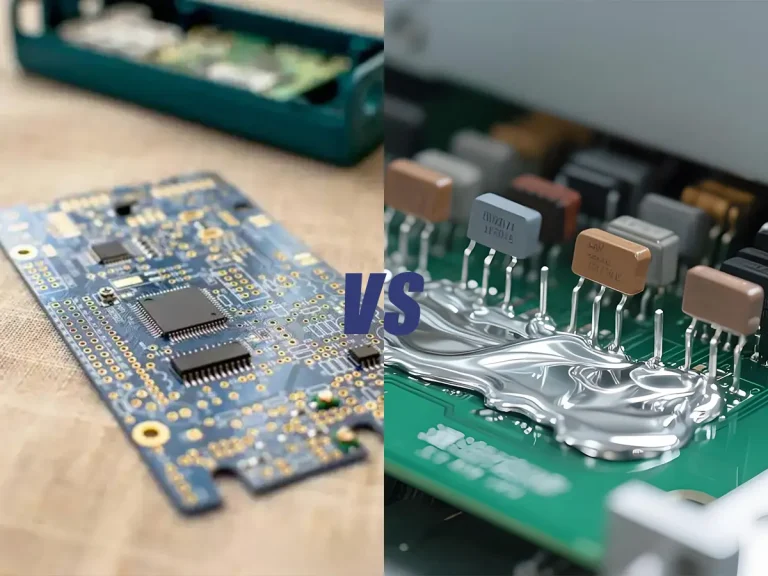
Leaded solder and lead-free solder are the two most commonly used alloys in electronics assembly.
The main differences come down to melting temperature, usability, reliability, and compliance requirements.
Leaded solder is easier to work with, while lead-free solder is required in most modern electronics manufacturing due to environmental regulations.
In this guide, we break down the real differences between the two, how they behave in practice, and which one is suitable for different soldering applications.
What Is Leaded and Lead-Free Solder?
Solder is a metal alloy used to join electronic components to a PCB by melting and solidifying the material.
Leaded solder
Leaded solder is typically made from tin (Sn) and lead (Pb), with common compositions like Sn63/Pb37 or Sn60/Pb40.
It has been widely used in electronics for decades due to its:
- Low melting point
- Easy wetting behavior
- Smooth and shiny joints
- Stable soldering process
Lead-free solder
Lead-free solder removes lead entirely and replaces it with metals such as tin, silver, and copper (commonly SAC305: Sn96.5/Ag3.0/Cu0.5).
It was widely adopted after environmental restrictions such as RoHS requirements in global electronics manufacturing.
Key Differences Between Leaded and Lead-Free Solder
The difference between these two types is not just material composition. It directly affects how the solder behaves during real work.
1. Melting Temperature
Leaded solder melts at around 183°C, while lead-free solder typically melts at 217–227°C.
This higher temperature means:
- More heat is required
- Components are exposed to higher thermal stress
- PCB materials must withstand more heat
2. Wetting and Flow Behavior
Leaded solder flows more easily and wets copper surfaces faster.
Lead-free solder:
- Spreads more slowly
- Requires stronger flux activity
- Needs cleaner surfaces for good results
This is one reason many technicians feel leaded solder is “easier to control” during manual work.
3. Appearance of Solder Joints
Leaded solder joints are usually shiny and smooth.
Lead-free solder joints often appear:
- Matte
- Duller
- Less reflective
This does not necessarily mean a bad joint. It is simply a difference in alloy structure.
4. Oxidation Behavior
Lead-free solder oxidizes faster at high temperatures, especially during prolonged heating.
This leads to:
- Faster tip contamination
- More frequent cleaning required
- Increased maintenance workload
5. Mechanical Properties
Leaded solder is softer and slightly more forgiving under mechanical stress.
Lead-free solder is harder and can be more brittle in some conditions, especially under thermal cycling.
However, modern formulations have improved reliability significantly in industrial production.
Why the Industry Moved Toward Lead-Free Solder
The main reason is not performance, but regulation and environmental safety.
Lead is a toxic heavy metal, and long-term exposure can pose health and environmental risks if not properly controlled.
Because of this, many global electronics standards require lead-free solder in:
- Consumer electronics
- Automotive electronics
- Mass production PCB assembly
Leaded solder is still used in:
- Repair work
- Aerospace and military systems (in some cases)
- Legacy electronics maintenance
Advantages and Disadvantages of Each Type
Leaded solder advantages
- Lower melting temperature
- Easier for beginners
- Better wetting behavior
- More forgiving during rework
- Stable solder joint formation
Leaded solder disadvantages
- Contains toxic lead
- Restricted in many countries for manufacturing
- Environmental disposal concerns
Lead-free solder advantages
- Environmentally compliant
- Required for modern electronics production
- Safer in long-term regulatory context
- Strong mechanical structure in many applications
Lead-free solder disadvantages
- Higher working temperature
- Harder to control for beginners
- Faster oxidation
- Requires better temperature control and flux quality
Which One Is Better for Electronics Soldering?
There is no absolute “better” choice. It depends on application.
Leaded solder is better for:
- Learning soldering
- Repair and rework
- Precision hand soldering
- Low-volume electronics work
Lead-free solder is better for:
- Mass production
- Export-compliant products
- Industrial manufacturing lines
- Modern consumer electronics
In real-world practice, many technicians still prefer leaded solder for manual work because of its ease of use, while lead-free dominates production environments.
Common Misunderstandings About Lead vs Lead-Free Solder
“Lead-free solder is always safer in every way”
It is safer environmentally, but not necessarily easier to work with or more forgiving during soldering.
“Lead solder joints are always better”
Leaded solder provides easier visual inspection and smoother flow, but modern lead-free processes can achieve highly reliable joints with proper control.
“Lead-free solder is lower quality”
It is not lower quality. It is simply different in behavior and requires tighter process control.
Practical Soldering Considerations
In real soldering environments, performance depends on more than just alloy type.
Key factors include:
- Temperature control
- Flux quality
- Tip condition
- Operator skill
- PCB surface finish
Poor soldering results are often caused by technique or heat control issues, not the solder type itself.
Frequently Asked Questions
Is leaded solder better than lead-free solder?
Leaded solder is easier to use, but lead-free solder is required in most modern manufacturing due to regulations.
Why is lead-free solder harder to use?
It requires higher temperatures and has slower wetting behavior, making it less forgiving during manual soldering.
Does lead-free solder make weaker joints?
Not necessarily. When properly processed, lead-free solder joints are reliable and widely used in industrial electronics.
Can you mix leaded and lead-free solder?
Yes, but it creates mixed alloy behavior and is generally not recommended for precision work or production environments.
Why does lead-free solder look dull?
This is normal due to its metallurgical structure and does not automatically indicate a bad joint.
Conclusion
Lead vs lead-free solder is not a simple question of better or worse. It is a trade-off between usability and compliance.
Leaded solder is easier for manual work and repair applications, while lead-free solder is the global standard for modern electronics manufacturing.
Understanding how each behaves in real soldering conditions is more important than simply choosing one over the other.
A skilled technician can achieve reliable results with either type, as long as temperature control, flux, and technique are properly managed.
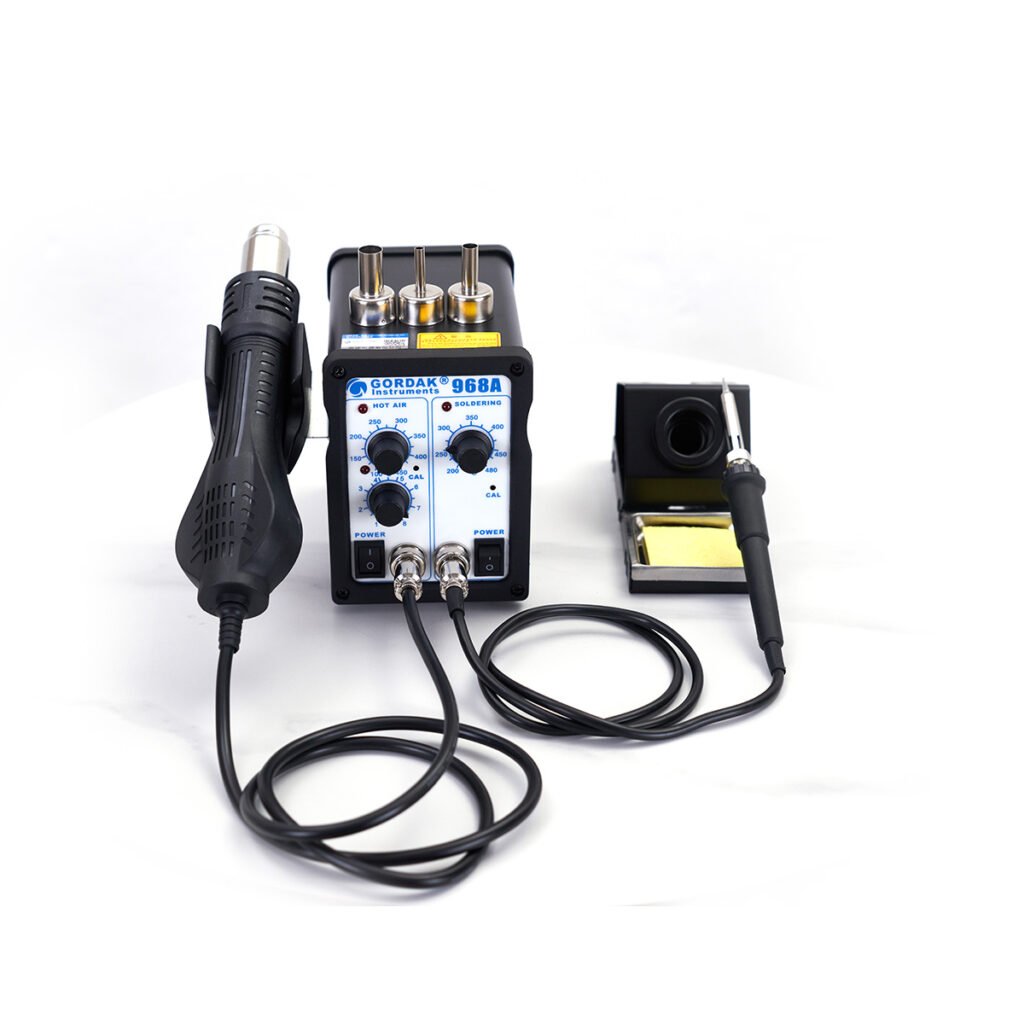
Looking for stable, professional soldering performance for both leaded and lead-free applications? Explore GORDAK info@gordakelec.com soldering and rework stations built for precision, durability, and industrial reliability.