Desoldering surface-mounted devices (SMDs) is a critical process in electronics repair, rework, and prototyping. With increasing use of compact and densely populated PCBs, having the right tools and techniques is essential. One of the most effective and non-invasive tools for this job is the hot air rework station.
At Gordak Electric, we specialize in developing reliable, easy-to-use hot air rework stations that support technicians and engineers in achieving safe and efficient desoldering results. In this guide, we explain how to properly desolder SMD components using a hot air rework station.
Why Use a Hot Air Rework Station for SMD Desoldering?
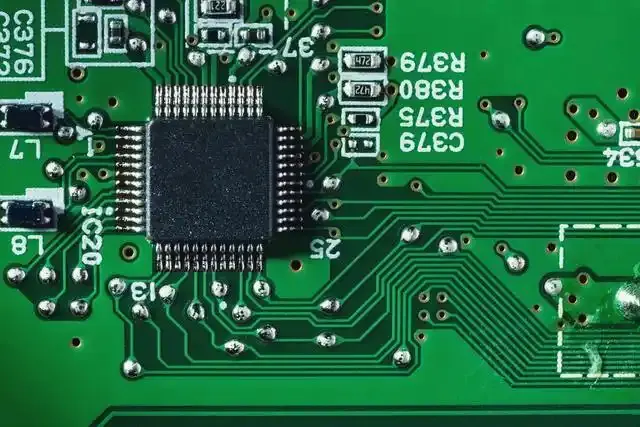
SMD components are soldered directly onto the PCB surface and often have multiple fine-pitch leads or pads. Traditional soldering irons can struggle with such precision work. A hot air rework station:
- Provides contact-free heat, reducing risk of mechanical damage
- Allows for uniform heating, especially on multi-pin components
- Is suitable for a wide range of SMD packages, including SOIC, QFP, and BGA
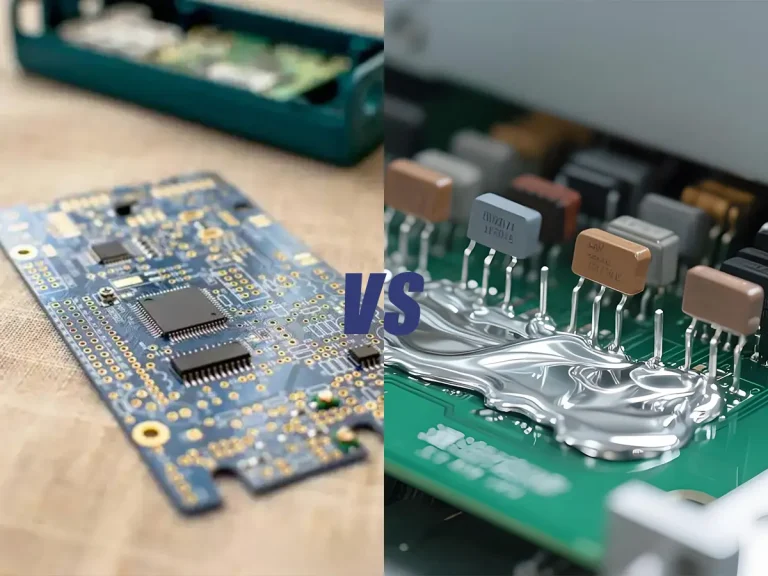
Hot Air Rework Station vs Other Desoldering Methods
Before removing an SMD component, it is important to choose the right desoldering method. Different tools are suitable for different repair situations.
Hot Air Rework Station
A hot air rework station is the preferred solution for removing SMD components with multiple solder joints.
Advantages include:
- Even heating across multiple pins
- No direct contact with the component
- Lower risk of mechanical damage
- Suitable for ICs and fine-pitch components
It is commonly used for:
- SOIC removal
- QFP rework
- QFN replacement
- PCB repair applications
Soldering Iron
A soldering iron works well for simple solder joints but is less efficient for multi-pin SMD components.
It is mainly used for:
- Through-hole components
- Wire soldering
- Single-point solder correction
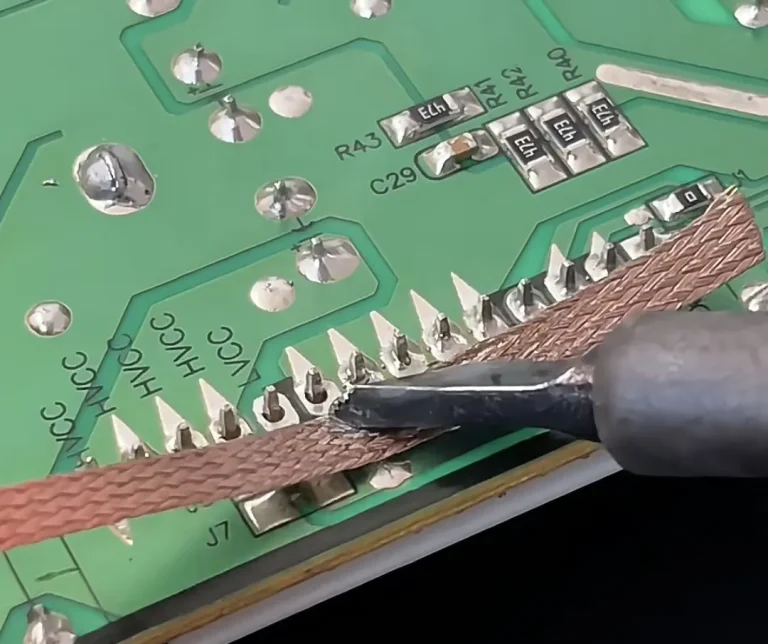
Desoldering Pump or Solder Wick
Desoldering pumps and solder wick are useful for removing excess solder, but they cannot easily remove many SMD components because the solder joints must be heated individually.
For modern PCB repair, a hot air rework station provides better control and efficiency when removing surface-mounted components.
Tools You’ll Need
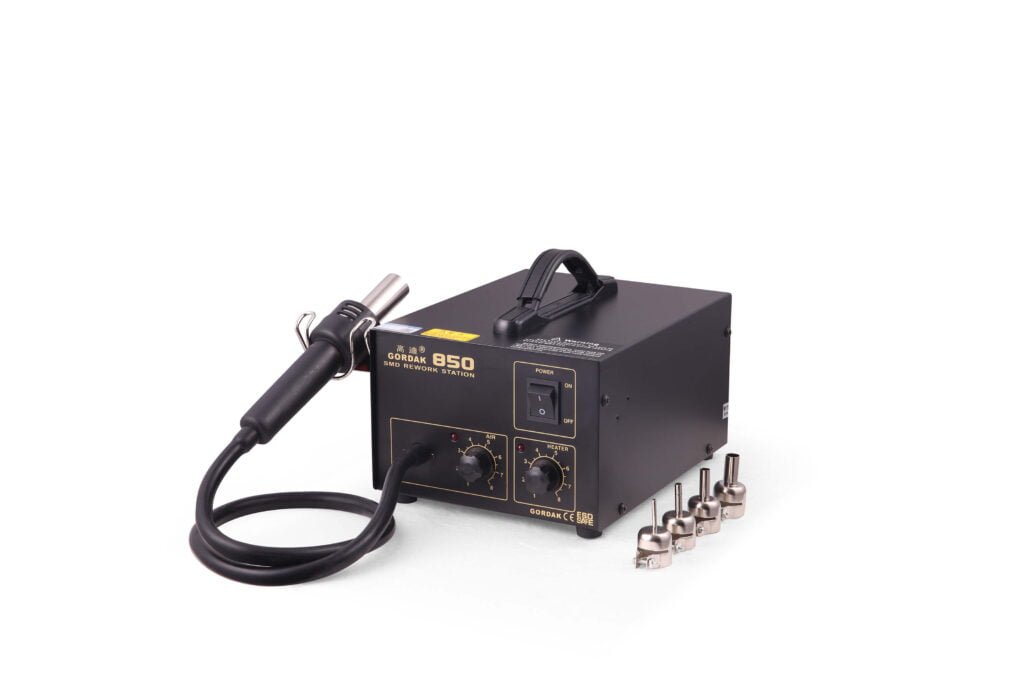
- Hot air rework station (e.g., Gordak 850, Gordak 857, Gordak 958 series)
- Anti-static tweezers or vacuum pickup tool
- Flux (optional, but recommended)
- Magnification (optional for small components)
- Solder wick or solder sucker (for cleaning residual solder)
- ESD-safe mat and wrist strap (for static protection)

Step-by-Step Guide to Desoldering SMD Components
1. Power on the Rework Station and Set Parameters
- Temperature: Set to around 280°C to 350°C, depending on the solder type and board sensitivity
- Airflow: Use low to medium airflow to avoid displacing nearby components
- Wait for the hot air gun to reach the set temperature before proceeding
2. Prepare the Work Area
Ensure your PCB is clean, dry, and secured on an anti-static surface. Apply a small amount of flux around the component to help the solder melt evenly and reduce oxidation.
3. Select the Correct Nozzle
Choose a nozzle that suits the size of the component. A smaller nozzle offers better control over airflow and heating focus.
4. Apply Heat Evenly
Hold the hot air gun about 2–4 cm above the component. Move the nozzle in gentle circular or side-to-side motions to distribute heat evenly across all solder joints. Avoid holding the nozzle still to prevent overheating the board.
Watch closely — as the solder melts, the component will become free.
5. Lift the Component
Once the solder is molten, carefully lift the component using anti-static tweezers or a vacuum pickup tool. Do not force it—if there’s resistance, continue applying heat for a few more seconds.
6. Clean the Pads
After removal, clean the remaining solder from the pads using solder wick or a solder sucker, followed by gentle wiping with isopropyl alcohol. This ensures a clean surface for future reinstallation or inspection.
7. Cool Down and Power Off
After desoldering, return the hot air gun to its holder. Allow the air to run for a short time to cool the heating element (especially in Gordak models with intelligent cooling), then switch off the station safely.
Hot Air Desoldering Techniques for Different SMD Packages
Different SMD packages require different heating approaches because their size, pin structure, and thermal characteristics vary.
Small Passive Components
Small components such as resistors and capacitors usually require lower airflow and shorter heating time.
Recommended approach:
- Use a small nozzle
- Apply moderate heat
- Avoid excessive airflow that may move nearby components
SOIC and QFP Components
Multi-pin IC packages require even heating across all solder joints.
Recommended approach:
- Apply flux around the pins
- Select a nozzle covering the component area
- Move the nozzle evenly around the package
The component should be removed only after all solder joints become fully molten.
QFN Components
QFN packages can be more challenging because they include pads underneath the component.
Proper heat transfer is important.
Recommended practices:
- Apply sufficient flux
- Use controlled airflow
- Allow enough heating time for the bottom pad to reach reflow temperature
BGA Components
BGA removal usually requires more advanced rework equipment and controlled heating processes.
Professional applications often use:
- Preheating systems
- Temperature profiling
- Specialized rework equipment
A hot air rework station can assist with localized heating, but careful control is essential to avoid PCB damage.
Why Does Solder Not Melt During Hot Air Desoldering?
A common problem for beginners is that the component does not come loose even after applying hot air.
This does not always mean the hot air rework station lacks power. Several factors can prevent solder from reaching its melting point.
Incorrect Temperature Setting
Different solder alloys require different temperatures.
Lead-free solder generally requires more heat than traditional leaded solder. However, increasing temperature excessively is not always the solution because it may damage the PCB or nearby components.
A better approach is to use a suitable temperature setting combined with proper airflow and heating time.
Large PCB Thermal Mass
Large copper areas and multilayer PCBs absorb heat and distribute it away from the target area.
This thermal mass effect means:
- Larger boards require more heating time
- Ground planes may delay solder melting
- Components may not release immediately
Gradual heating is often more effective than applying extremely high temperatures.
Insufficient Flux Application
Oxidized solder surfaces do not transfer heat efficiently.
Applying flux helps:
- Remove oxidation
- Improve solder flow
- Allow more consistent reflow
For difficult desoldering tasks, additional flux can significantly improve results.
Incorrect Airflow Settings
Temperature alone does not determine heating performance.
Too much airflow may:
- Move small components
- Reduce heating accuracy
- Spread heat away from the target area
Using controlled airflow allows heat to reach the solder joints more effectively.
Safety Tips
- Always wear eye protection when working with hot solder
- Use ESD-safe tools and environment to protect sensitive components
- Avoid overheating the PCB to prevent pad lifting or delamination
- Practice on scrap boards before working on valuable electronics
How to Choose a Hot Air Rework Station for SMD Desoldering
Choosing the right hot air rework station directly affects repair accuracy, efficiency, and PCB safety.
When selecting equipment for SMD desoldering, consider the following factors:
Stable Temperature Control
Accurate temperature control helps prevent:
- Component overheating
- PCB damage
- Incomplete solder melting
A reliable station should maintain consistent heat output during operation.
Adjustable Airflow
Different SMD components require different airflow levels.
A good hot air rework station should provide precise airflow adjustment for:
- Small passive components
- Fine-pitch ICs
- Larger packages
Nozzle Compatibility
A variety of nozzle sizes allows technicians to match the heating area with different component types.
Proper nozzle selection improves heating efficiency and reduces unnecessary heat exposure to surrounding areas.
Cooling and Safety Functions
Professional rework stations often include cooling functions that protect the heating system and extend equipment lifespan.
These features are especially important for repair shops and users performing frequent PCB rework.
Why Choose Gordak Electric?
Gordak Electric is a leading manufacturer of hot air rework stations and soldering solutions. Our equipment is trusted globally for its:
- Stable and precise temperature control
- Durable, high-efficiency design
- User-friendly interfaces for both beginners and professionals
- OEM and ODM support for global clients
To learn more about our product range or request a quotation, please contact us:
Email: info@gordakelec.com