• +8618025978448
  • info@gordakelec.com
× 发送

Hot Air Rework Station vs Desoldering Station: Which One Should You Use?

Hot air rework stations and desoldering stations are both widely used in PCB repair, but they serve completely different purposes.

Choosing the wrong tool often leads to inefficient rework, damaged components, or poor solder removal results.

This guide explains how each tool works, when to use them, and how professionals decide between the two in real electronics repair environments.

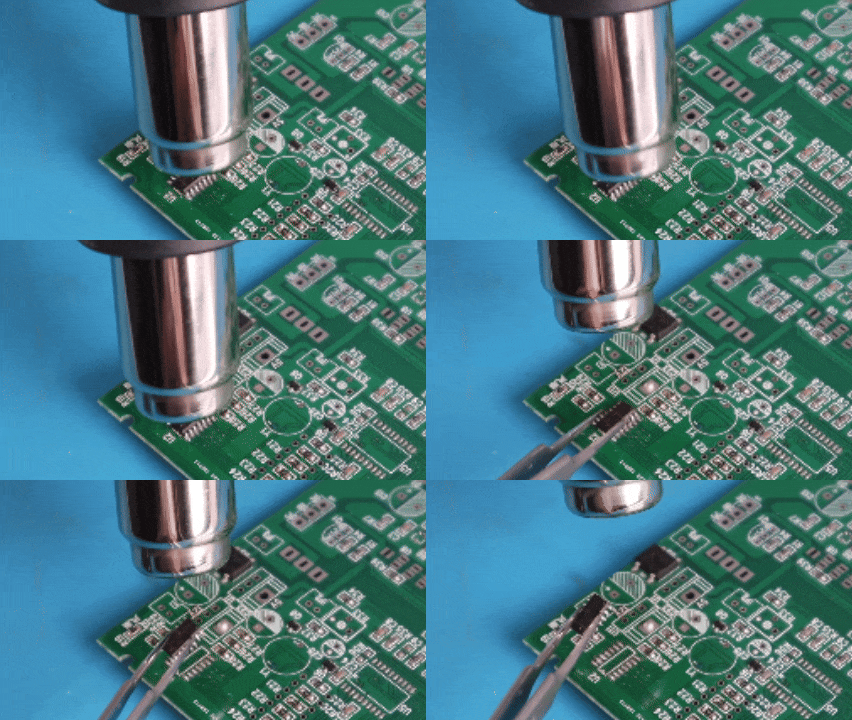
A hot air rework station is a precision tool that uses controlled hot air to heat solder joints on a PCB.

Instead of heating a single point like a soldering iron, it heats an entire area, allowing multiple solder joints to reach melting temperature at the same time.

Main functions:

  • SMD component removal
  • IC rework and replacement
  • PCB solder correction
  • Reflow of defective joints

It is essential in modern SMT (Surface Mount Technology) repair because most components are densely packed and multi-pin.

How it works

A hot air rework station operates by combining:

  • A heating element
  • A controlled airflow system

The operator adjusts:

  • 温度
  • Air volume
  • Nozzle size

Hot air is then directed onto the PCB, gradually heating solder until it reaches its reflow point.

At this stage:

  • Components can be lifted safely
  • Solder joints become liquid
  • Rework becomes possible without direct contact
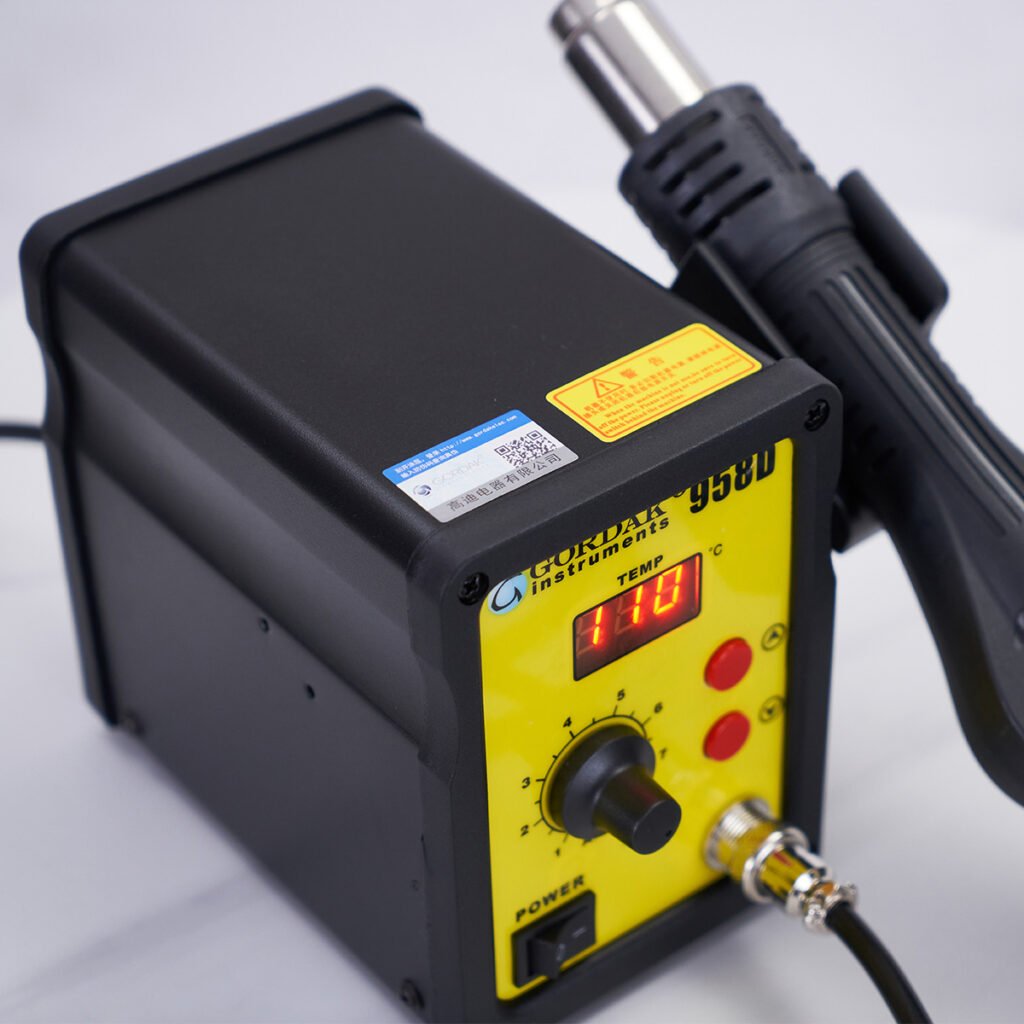
GORDAK 958D Hot Air Rework Station

A desoldering station is a tool designed to remove molten solder from a joint using heat and vacuum suction.

Unlike hot air rework, it focuses on:

  • One solder joint at a time
  • Through-hole components
  • Pin-by-pin removal

Main functions:

  • Remove solder from through-hole PCB joints
  • Extract components with pins
  • Clean solder holes for reassembly

It is commonly used in older PCB designs or assemblies with through-hole components.

How it works

A desoldering station typically uses:

  • A heated nozzle
  • A vacuum pump

The process:

  1. Heat solder joint
  2. Melt solder
  3. Activate suction
  4. Remove molten solder from hole

This allows the component lead to be released cleanly.

Although both tools are used for PCB repair, their operation and purpose are fundamentally different.

Heating method

  • Hot air rework: heats entire area using airflow
  • Desoldering station: heats one point and extracts solder

Type of components

  • Hot air rework: SMD components, IC chips, QFP/QFN packages
  • Desoldering station: through-hole components

Functionality

  • Hot air rework: reflow, remove, and replace components
  • Desoldering station: remove solder only

Precision style

  • Hot air: area-based heating
  • Desoldering: point-based extraction

Skill requirement

  • Hot air rework: requires temperature and airflow control
  • Desoldering station: requires timing and suction control

A hot air rework station is the preferred tool when working with modern PCB assemblies.

Best use cases:

  • Removing SMD components
  • Replacing IC chips
  • Repairing solder bridges
  • Fixing misaligned components
  • Reworking surface-mounted parts

It is especially important in SMT boards where components are densely packed and cannot be accessed individually.

Why professionals prefer hot air for SMD

Most modern electronics use surface-mounted components. These components:

  • Have multiple solder points
  • Require simultaneous heating
  • Cannot be removed one pin at a time

Hot air allows uniform heating, which makes safe removal possible.

When to Use a Hot Air Rework Station

A desoldering station is most effective in traditional PCB repair workflows.

Best use cases:

  • Through-hole component removal
  • Connector replacement
  • Cleaning solder from vias
  • Old PCB maintenance

Why it is still important

Even in modern electronics, many devices still include:

  • Power connectors
  • Large capacitors
  • Mechanical pins

These are better handled using vacuum desoldering instead of hot air.

There is no universal “better” tool. The correct choice depends on PCB structure and component type.

Hot air rework is better for:

  • SMD electronics
  • Modern compact PCBs
  • Multi-pin IC components
  • Reflow-based repairs

Desoldering station is better for:

  • Through-hole boards
  • Older electronic devices
  • Single-pin solder removal
  • Connector repair

Professional reality

In real repair environments, technicians often use both tools together:

  • Hot air → SMD rework
  • Desoldering → through-hole removal

This combination covers nearly all PCB repair scenarios.

In real PCB repair environments, incorrect tool selection is one of the main causes of low efficiency and board damage.

Using hot air for through-hole components

A common mistake is trying to remove through-hole parts with hot air.

Problems include:

  • Uneven heating inside plated holes
  • Solder not fully clearing from vias
  • Risk of overheating surrounding components
  • Slow and inefficient removal process

Hot air is not designed for deep hole solder extraction.

Using desoldering station for SMD components

Another frequent mistake is attempting to remove SMD ICs using a desoldering pump.

Issues include:

  • Cannot reach all solder joints simultaneously
  • High risk of pad damage
  • Excess mechanical force applied
  • Incomplete removal of multi-pin components

Desoldering stations are not designed for surface-mounted IC packages.

Ignoring board structure

PCB design strongly affects tool choice.

  • Multilayer boards → require thermal control (hot air)
  • Through-hole boards → require vacuum extraction
  • Mixed boards → require both tools

Failing to consider board structure leads to inefficient rework.

Overheating during hot air use

Many beginners increase temperature instead of improving technique.

This causes:

  • PCB pad lifting
  • Component damage
  • Delamination of board layers

Proper rework depends on controlled heating, not maximum temperature.

In industrial repair environments, hot air and desoldering stations are often used together in a structured workflow.

Workflow using hot air rework station

Typical steps:

  1. Apply flux to target area
  2. Preheat PCB evenly
  3. Use hot air to reach solder reflow temperature
  4. Lift SMD component carefully
  5. Clean pads for rework or replacement

This workflow is optimized for SMT-based boards.

Workflow using desoldering station

Typical steps:

  1. Heat through-hole solder joint
  2. Activate vacuum suction
  3. Remove molten solder from hole
  4. Extract component pin
  5. Clean and prepare vias for reassembly

This workflow is optimized for mechanical pin-based components.

Combined professional workflow

In real repair centers:

  • Hot air is used for IC and SMD sections
  • Desoldering is used for connectors and through-hole parts

This combination maximizes efficiency and reduces PCB damage risk.

From a technical repair standpoint, tool selection is not based on preference but on solder joint structure.

Decision principle 1: Number of solder joints

  • Multiple joints (ICs) → hot air
  • Single joint (pin) → desoldering

Decision principle 2: Component type

  • Surface-mounted → hot air
  • Through-hole → desoldering

Decision principle 3: Thermal behavior

  • Large thermal mass → hot air
  • Local solder point → desoldering

Decision principle 4: Repair objective

  • Reflow / reposition → hot air
  • Remove solder completely → desoldering

In professional environments, technicians do not ask “which tool is better”, but instead:

“What is the solder structure and what is the fastest safe method?”

Can a hot air rework station replace a desoldering station?

No. They serve different purposes. Hot air is for area heating, while desoldering is for solder extraction.

Which tool is better for PCB repair?

Both are required in professional environments. Hot air handles SMD, desoldering handles through-hole components.

Can desoldering stations remove SMD chips?

Not effectively. SMD components require simultaneous heating across all solder joints.

Is hot air safe for PCB components?

Yes, when temperature and airflow are properly controlled. Excess heat, however, can damage pads or components.

Do professionals use both tools?

Yes. Most electronics repair stations use both hot air rework and desoldering systems together.

Hot air rework stations and desoldering stations are not competing tools. They are complementary systems designed for different PCB structures and repair tasks.

Hot air rework is essential for modern SMT electronics, where components are densely packed and require simultaneous heating. Desoldering stations remain critical for through-hole components and precise solder removal.

In real-world electronics repair, efficiency comes from understanding when to use each tool rather than relying on a single solution.

For professional PCB repair and rework solutions, contact GORDAK at info@gordakelec.com to explore high-performance hot air rework stations and OEM/ODM cooperation opportunities.

Please enable JavaScript in your browser to complete this form.