Soldering is an incredibly important process, and getting the best results from your soldering efforts starts before you’ve even got the materials on the bench in front of you. Luckily, our friendly experts have outlined some of the main things you need to know about soldering irons and soldering guns; hopefully, this will help you find the right equipment for your needs, whatever they might be.
Soldering Iron vs Soldering Gun: Key Differences
The main difference between a soldering iron and a soldering gun is how they deliver heat and how much control they provide during soldering. A soldering iron is generally better suited to precision electronics work, while a soldering gun is more useful for larger joints, heavy wires, and applications that require higher heat output.
| Feature | Soldering Iron | Soldering Gun |
|---|---|---|
| Typical application | PCB and electronics repair | Heavy-duty soldering |
| Heat delivery | Heated tip | High-current heating element or tip |
| Precision | High | Lower |
| Temperature control | Available on many models | Often more limited on traditional models |
| Tip size | Wide range | Generally larger |
| Best for | SMD and through-hole components | Thick wires and large joints |
| Heat output | Low to high, depending on model | Generally high |
| Continuous precision work | Well suited | Less convenient |
| PCB repair | Generally preferred | Suitable only for certain applications |
For electronics repair, the important consideration is not simply which tool produces more heat. Temperature control, tip geometry, thermal recovery, and the size of the workpiece all affect soldering performance.
Soldering Iron vs Soldering Gun: What’s the Difference?
Soldering irons and soldering guns might seem similar, but in reality, there are several significant differences that you should know. Soldering irons are small, one-handed devices that are used for applications needing more accurate work thanks to their smaller design and excellent versatility. In contrast, soldering guns are larger devices that feature a handheld design that’s more akin to a drill or driver.
Which is Better: Soldering Iron or Soldering Gun?
Both soldering irons and soldering guns offer a range of benefits, but it’s worth keeping in mind here that each is designed for very different applications.
Soldering irons are a more traditional option, and their streamlined baton-like design can potentially make them easier to use in smaller spaces and for more precise work. They are also significantly lighter in weight than soldering guns and tend to retain heat for much longer. As such, if you’re likely to need a tool that offers long-term usage and solutions, a soldering iron may be able to retain its heat for longer without needing to reheat.
Contrastingly, while soldering guns can be a little bulkier to use and may need to reheat, they do offer a wealth of benefits. For one thing, soldering guns tend to pack much more power than irons, making them useful for heavy-duty jobs compared to traditional soldering irons. Furthermore, soldering guns provide almost instantaneous heating and cooling, which provides a much more rapid option and can potentially help prevent injuries and the like from leaving a hot soldering iron lying around; the immediate cooling also helps. However, we should stress that this does mean soldering guns may stay hot for less time compared to soldering irons, so they may need to reheat occasionally.
Can You Use a Soldering Gun for PCB Soldering?
A soldering gun can be used for some PCB soldering tasks, but it is generally not the preferred tool for precision PCB work. Traditional soldering guns are designed to deliver high heat output and are better suited to large solder joints, thick wires, and other applications with high thermal mass.
For PCB repair, a temperature-controlled soldering iron usually provides better control over the amount of heat delivered to an individual solder joint. This is especially important when working near small components, fine traces, and heat-sensitive parts.
A soldering iron is generally the better choice for:
- SMD components
- Through-hole components
- Fine-pitch connections
- Small PCB pads
- Electronic components
- Precision PCB repair
A soldering gun can be useful when a PCB contains unusually large solder joints or heavy wires that require substantial heat transfer. However, using excessive heat simply because a soldering gun is available can increase the risk of overheating pads, components, or nearby areas of the board.
The key is to match the tool to the thermal requirements of the joint rather than choosing the highest-powered tool available.
Is Higher Wattage Better for Soldering?
Higher wattage does not automatically mean better soldering performance. Soldering power determines how much electrical power a tool can deliver, but the actual soldering result also depends on temperature regulation, tip design, thermal recovery, and the thermal mass of the workpiece.
For small electronic components, excessive power can make heat control more difficult if the tool does not regulate temperature effectively. For large connectors, heavy wires, or large copper areas, however, a higher-power soldering tool can provide the thermal recovery needed to maintain the required working temperature.
In practice:
- Low thermal mass: prioritize precision and temperature control.
- Large copper areas: prioritize thermal recovery and suitable tip size.
- Heavy wires: higher power may be beneficial.
- Fine-pitch PCB work: temperature stability and control are more important than maximum wattage.
This means that soldering iron wattage should be considered together with temperature control and application requirements rather than used as the only measure of performance.
Soldering Iron vs Soldering Station vs Soldering Gun
A soldering iron, soldering station, and soldering gun are not interchangeable tools. Although all three can melt solder, they are designed for different levels of control and different applications.
Soldering Iron
A basic soldering iron consists of a heated handle and soldering tip. It is suitable for simple soldering tasks, wires, connectors, and basic electronics repair.
Soldering Station
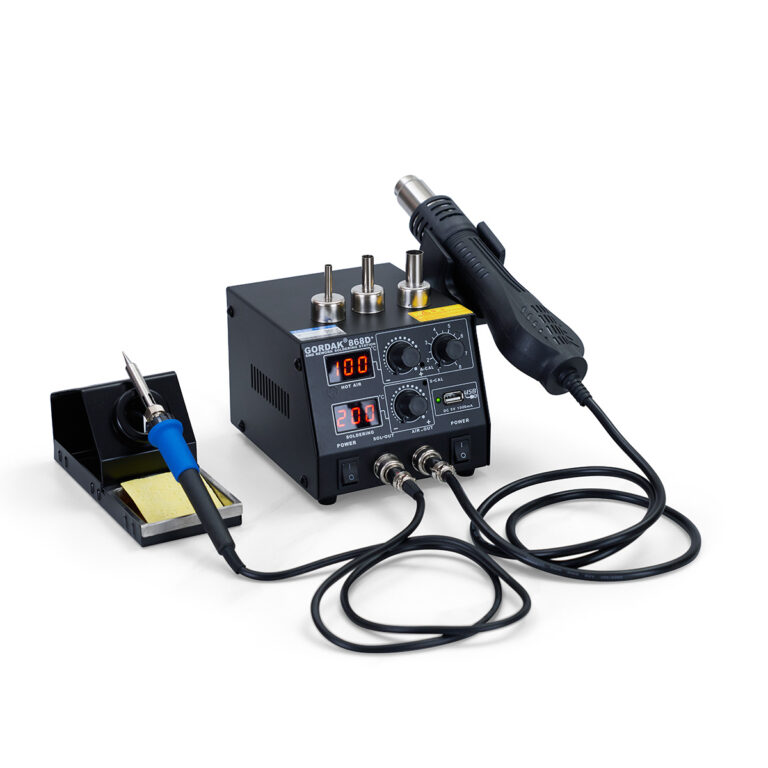
A temperature-controlled soldering station provides a separate control unit that regulates the temperature of the soldering iron. This makes it better suited to precision electronics work, PCB assembly, and repeated soldering tasks.
Soldering Gun
A traditional soldering gun is designed for applications that require higher heat output. It is commonly used for larger wires, terminals, and heavy-duty solder joints rather than fine PCB work.
For professional electronics repair, a temperature-controlled soldering station is often the most versatile choice because it provides greater control over temperature and heat delivery.
If you want to understand the differences in greater detail, see our guide to soldering iron vs soldering station.
Which Is Better for SMD and Through-Hole Soldering?
The best soldering tool depends on the component type, joint size, and thermal requirements of the PCB.
Soldering Tools for SMD Components
For SMD components, a temperature-controlled soldering iron is generally more suitable than a traditional soldering gun. Its smaller tip and adjustable temperature make it easier to control heat around compact components.
For more complex SMD packages, such as multi-pin ICs, QFPs, QFNs, and other components with difficult-to-access solder joints, a hot air rework station may be more appropriate.
Soldering Tools for Through-Hole Components
Through-hole components generally provide more accessible solder joints, making them suitable for soldering irons. However, large connectors, terminals, and components connected to large copper areas may require a higher-power iron or another tool capable of delivering more thermal energy.
The important factor is therefore not simply whether a component is SMD or through-hole. The size of the joint, PCB thermal mass, component sensitivity, and required heat transfer should also be considered.
How Tip Size and Temperature Control Affect Soldering
Tool selection is only part of the equation. The soldering tip and temperature settings also have a major effect on heat transfer and soldering efficiency.
Soldering Iron Tip Size
A small tip provides better access to compact solder joints, while a larger tip can transfer heat more effectively to larger joints and high-thermal-mass areas.
Using an unnecessarily small tip on a large copper pad may require longer heating time. Conversely, an oversized tip can make precision work more difficult.
The goal is to use a tip that provides enough contact area for efficient heat transfer without interfering with nearby components.
Temperature Control
Temperature control is particularly important when working with modern PCBs and lead-free solder. The correct working temperature depends on the solder alloy, component, PCB structure, and thermal mass.
Using excessive temperature can increase the risk of:
- PCB pad lifting
- Component damage
- Flux degradation
- Tip oxidation
- Solder mask damage
For more information about temperature selection, see our guide to the best soldering temperature for PCB work.
ESD and PCB Safety Considerations
When working on electronic circuits, heat is not the only consideration. Electrostatic discharge (ESD) can also damage sensitive semiconductor devices.
Components such as ICs, microcontrollers, MOSFETs, and sensors may be sensitive to electrostatic discharge. For this reason, professional electronics repair environments should use appropriate ESD control practices.
Depending on the application, these may include:
- ESD-safe soldering equipment
- Proper equipment grounding
- ESD wrist straps
- ESD work surfaces
- Proper handling and storage of sensitive components
A soldering tool should therefore be evaluated not only by its heating performance but also by whether it is appropriate for the electronic environment in which it will be used.
Which is Right for Me?
Considering the aforementioned factors, soldering irons tend to be a better option for those needing a lightweight and precise soldering tool. However, a soldering gun is a lot more powerful and practical in many cases for its instant cooling and more ergonomic handling, making these options ideal choices for many people. However, if you’re not entirely sure which option is right for your needs, make sure to contact a professional soldering equipment provider to see if they can help.
Final Thoughts
If you’ve been looking to begin soldering, ensuring you have the necessary equipment in place is vital. Fortunately, today’s brief guide has outlined some of the main things you should know about soldering irons and soldering guns; this should help you decide which tool is most suitable for your needs. If you have further questions, please contact us at info@gordakelec.com.
Soldering Equipment Comparisons
Soldering Iron vs. Soldering Station: Which is the Right Tool for You?
Soldering Iron Vs Soldering Station
Soldering Iron vs Soldering Gun: Which is Better?
What Is The Difference Between a Soldering Iron And A Rework Station?